
User Tools
Sidebar
2 Vancouver Island Circumnavigation Attempts 2017 - Mike Gill, Nicholas Cryder
(Ed. For more see Vancouver Island Circumnavigations )
from 2019 Men's Journal article
Only a day apart — on June 9 and 10 — two paddlers launched separate attempts to best a hallowed benchmark in sea kayak speed: the self-supported circumnavigation of Vancouver Island. Nicholas Cryder and then Mike Gill set out, respectively, to improve on the record time of 12 days 23 hours and 45 minutes set in June 2014 by Victoria, B.C. native Russell Henry.
Neither Cryder nor Gill, however, were able to successfully complete the ambitious voyage of roughly 650 statute-miles around the waters of the massive Pacific Northwest island, leaving Henry’s sub-13-day time intact atop a lineage of speed-hungry expedition kayakers that has included previous records by Joe O’Blenis and Sean Morley.
Cryder and Gill encountered obstacles of both the physical and mental variety, proving just how tempestuous a trip around the island can be. Not to mention a race against the clock. Or the bears.
Cryder, who also made an 2015 attempt at the circumnavigation, launched his surfski from Port Hardy during the early morning hours of June 9, starting in a northwesterly direction to round the upper end of the island on his counter-clockwise loop. Less than 24 hours into his trip, Cryder had a scary encounter with an island resident.
“Very close call last night with an aggressive bear that charged and swung at me at 1 am,” Cryder shared via Garmin inReach, a GPS tracking and messaging system used by both paddlers on the voyage. “Scared him off with some help from fellow campers.”
Hours from Cryder’s bear encounter, Gill, a paddling school director at Deep Cove Kayak in North Vancouver, launched from Kain’s Island – the same region from which Russell Henry embarked in 2014 – leaving at 9:04 a.m., on June 10, heading south on his own counter-clockwise loop starting with a transit of the exposed west coast of Vancouver Island.
Before leaving, Gill learned that Cryder had set off over 24 hours earlier, 80 miles behind where he was launching, and heading his way.
“I kept looking over my shoulder expecting to see him coming up behind me,” says Gill, acknowledging Cryder’s fitness levels. Cryder, however, despite being camped a mere 10 miles behind Gill’s launch point, would never have the opportunity the catch him. On his second day of paddling, Cryder found a leak in his ‘ski.
“Houston we have a problem,” Cryder messaged through Garmin, “stopped for lunch at Lawn Point and discovered my ski is taking on water.” The crack discovered was 10 inches long, forcing Cryder to end his campaign within the first 48 hours.
Nicholas's description in Whatcom Paddlers listserv of finding the crack and getting home safely:
Thanks guys. Yesterday was a very extreme go. 4 meter breaking seas broke my ski. It was a very close call, and in that part of ocean a water logged boat isn't as simple as just going to shore and hoping in your truck and sharing a new war story over a beer. I was about 3 miles or so off shore and roughly 12 miles out from Brooks when I noticed the ski was getting heavier, so I changed course for Lawn Point to get some lunch and evaluate. Lawn Point was in extreme condition and I was in survival mode getting in, knowing that I had little chance of remount but battling waves landing on me in steep seas with a boat that was starting to sink. It's an ugly feeling where you want to question life choices but just don't have time because you're too busy trying to stay alive. At Lawn Point I came ashore and saw a 10“ crack had formed around the back hatch, and was propogating thru the tail section and there was roughly 3 gallons of water or so in the ski. Thankful it held up, but I was in a very isolated spot with a broken boat and I knew that my trip was over. At Kirks urging I had brought some fiberglass and resin, and set about trying to repair and stop the crack on the inside, but it didn't want to adhere with the water softened material. I used duck tape on the outside to stop the water and called it good. This morning I made a dash to quatsino sound at 5am, and had to paddle 12 miles of very rugged water (4 meter seas, wind at 35mph) to get to flat water, and then paddle another 25 miles to Port Alice for a transport back to Port Hardy. The repair job held the boat together, but there was a half gallon or so of water when I got to a small beach to see how I did.
I'm incredibly disappointed to have my mission cut short, but thankful to be ok and on my way home. The real lesson here is it's a mistake to miss a Wednesday nighter to go on an adventure. Never again!
Gill caught some better luck for the first leg of his attempt, cruising down the west coast on tailwinds, and averaging over 50 miles a day, keeping him within pace of Henry.
Progress of Mike Gill around Vancouver Island.
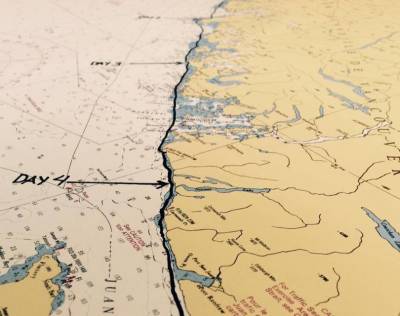
Upon reaching Victoria, Gill’s luck took a turn. A missed window in the currents meant a delay. Once able to continue to the inside channels, he encountered heavy headwinds, at times over 25 knots. Gill pushed on for days, but, with more wind forecast, the chances of besting Henry’s time dwindled. With hands covered in blisters painful enough to effect his sleep, Gill finally called it quits in the Johnstone Strait. On June 20, at 10 days and nearly 500 miles, Gill announced an end to his bid at the town of Kelsey Bay.
“The most surprising thing was how enjoyable the trip was,” says Gill, reflecting on his long days in the boat. He expected it to feel like more of a grind, he added, than a chance to take in the rugged beauty of the Pacific island. “I thought after Day Three I was just going to be hating it, but I really enjoyed just paddling every day.”
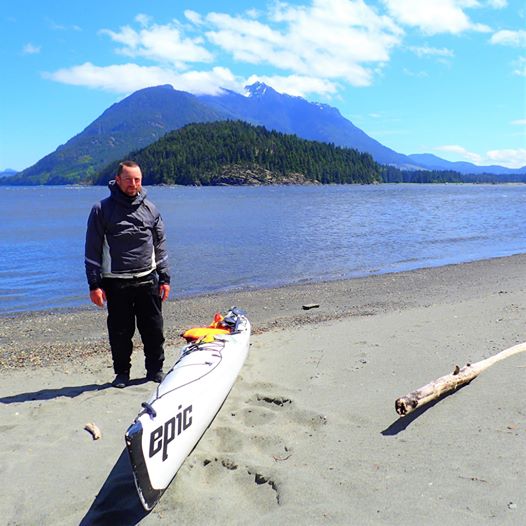
Gill believes he has learned a great deal of strategy from his first attempt regarding weather patterns, starting points, and gear selection. “When I stopped I told myself, ‘Never again,’” he says, considering the question of a future attempt, hands still healing from the battering. “A few days later I started thinking about it.”
Shedding that layer of self-doubt was also a critical component for Henry, who remains the record holder.
“At times on the trip I questioned why I was doing it,” Henry recounts of his 2014 run. “Sometimes it was pretty hard to get myself motivated to get up in the morning and keep going. After 12 to 14 hours on the water a day my body was wrecked. Not really individual muscles but more so an overall exhaustion. I can easily recall the feeling of laying down every night and how absolutely incredible it was.”
To this day, Henry too thinks of his hands when weighing the cost and benefits of one of expedition sea kayaking’s top prizes:
“Blisters on calluses on blisters,” Henry says. “Maybe not quite as bad as Mike’s were though when I saw him in Campbell River.”


