
User Tools
Sidebar
seattle
Table of Contents
Seattle, WA
.
.
Downwind West Point to Edmonds
Beyond Seattle
- …
Downwinders
Freshwater
- Lake Sammamish
- Idlywood Park laps video
- Lake Washington (watch for boat traffic) is a fresh water lake that is connects to Puget Sound via the Lake Washington Ship Canal and the Ballard Locks.
- Cedar River - Enatai Beach 5.5 miles
- Juanita Bay - one of those catcher's mitts that will catch you for a run with S, SW wind. video
- (washdown station at Juanita Beach Park with non-freeze showers on all winter)
- Sand Point
- Adams Street boat ramp - Sand Point 8 miles
- Madison Park - Sand Point 3 miles video
- Conditions on Lake
Marine
- Alki Point
- Dynamics similar to West Point (described below) with good surfing options on a strong S/SW wind against a flood current, creating ideal conditions for many laps. A large back eddy often forms north of the point, steepening and smoothing out the waves as one passes the point. Also possible to do a downwind run to West Point and beyond (or vice versa). Plenty of street parking near Alki Point Beach.
- Alki - West Point - Ballard Locks 8 miles video (paddler went on 7 miles more to Montlake)
- Duwamish Head
- Between Alki Point and West Point, Duwamish Head juts into Elliot Bay just west of the Duwamish Waterway (industrialized estuary of the Duwamish River).
- Good surfing on strong N/NW winds with ebb current out of Elliot Bay, especially if there is strong flow out of the Duwamish River (the Duwamish is the name for the last (lower) 12 miles of the Green River).
- Shilshole Bay
- Ballard Elks Club - Olympic Beach Park (Edmonds Marina) 10 miles video
- Balllards-West Point-Edmonds 12 miles (initial leg upwind) ripping OC downwinder
- SalmonBayPaddle
- Golden Gardens downwind laps
- Shilshole Bay - Apple Tree Lane (27th Ave NW?) approx 6 miles? video
- West Point (Discovery Park)
- A local favorite spot, is at the south end of Shilshole Bay with Discovery Park on the southside facing Elliot Bay
- Launch locations
- Ballard Elks Club (public beach) 1.5 mile paddle to the point. Street parking unless you are a member, but over the years, cars have quickly unloaded boats in the turn around circle and then been parked on the street, with no complaints.
- Discovery Park Beach but the beach parking lot is small and requires a permit from the Discovery Park office.
- Golden Gardens Park if the closer parking is really crowded or you want a bit more warmup (and/or possibly some following waves to surf in the summer) you can park here and paddle the 2.5 miles south to West Point
- North/NW wind with ebb current: If the wind is blowing out of the north or northwest at 15-25 knots, the 20 miles of fetch from Everett/Whidbey Island can generate 2-4 foot windwaves. When combined with an ebb current, large white caps form. Combined with gusty winds, the wave action can be somewhat chaotic and challenging. A large back eddy tends to form on the south side of Discovery Park beach, and one can sometimes surf a wave around the point into a protected lee where the waves become smooth and almost glassy, just tiny wind ripples. Conditions become truly challenging when a strong north wind weather front moves in with winds greater than 25 knots and waves in the 3 to 5 foot range.
- South/SW wind with flood current : Similar dynamics as above, just from opposite direction. However, there is a sand bar and shallows extending off the point which creates more consistent surfing opportunities and good lap intervals. Flood current max speed is rarely over 1 knot, but even a slight .5 knot opposing current steepens the waves significantly, opening up the possibility for long wave train rides.
- West Point - Golden Gardens 2.5 miles (south to north boundary of Shilshole Bay) easy downwind video
- West Point Lighthouse - Edmonds 10.5 miles video (1.5 miles upwind from Ballard to Lighthouse then downwind)
- …
Surfing Boat Wakes
- Lake Sammamish
- Lake Union
- West Mouth of Lake Washington Shipping Channel (Ballard Locks)
- On the south side of the west end channel mouth there are shallows that tend to build up waves whether they come from Freighters south bound in the Sound or smaller boats headed toward the Locks.
- West Point/Discovery Park Beach
- …
Tugboat Wake Surfing at West Point
Flat Water
- Local Lakes
- Always take care with cold water and most years you need to take adequate precaution for dealing with water in the mid 30’s F (1-3 C) in the winter in lakes.
- Green Lake - where Seattle Canoe and Kayak trains, with the goose poop and lack of fresh water recharge probably not great to take a swim…
- …
Conditions
- Summer Wind Pattern
- From Jim Schulz:
- “…mid/late afternoon wind in the summer almost every day during the months of April, May, June, July, and August…The simplest way to explain the wind pattern is: the Strait of Juan de Fuca is just west of Jetty, Whidbey, and Hat Islands and, almost every afternoon, winds get channeled through the Strait and spread out on the east side of the Puget Sound, Jetty (and the Seattle metro area) getting northwest winds. Those winds coming from the Juan de Fuca Strait are a product of several factors, but the two most important are daytime heating of the land surrounding the Strait and the fact that there is almost always higher pressure over the open ocean and lower pressure over inland Washington. Now air likes to flow from high to low pressure, so if there is higher pressure over the open Pacific than over Washington, the air filling the Strait will flow from west to east…”
- From Blue Crab on Standupzone:
- “… Puget Sound has a couple of interesting features. Our runs (Ed: he means the winds) typically are usually northerly in the summer, southerly the rest of the year and sometimes westerly. Each has a different character. The northerlies are rarely >20 mph but the fetch is 100s of miles with late afternoon winds circulating from the ocean through the Strait of Juan de Fuca and then south from the San Juan Islands. On these days, the swells can be nice sized but there is a slow motion feel to them. The glides are controlled and easy to catch but fairly difficult to connect. The shallower sections are almost always the best. Even when it gets to 25 mph, the deeper water sections are not that great. The sunshine and Rainier are highlights. These are perfect beginner runs and are doable at all tide levels.”
- Storms and the Rest of the Year
- From Blue Crab on Standupzone:
- “…Southerlies and westerlies are associated with big fall / winter storms and often occur before or after rain. Water depth seems to have much less of an effect on quality of swells. In fact, we usually shoot for the channel where the depth is 400-600 feet. Winds are gusty and temperamental, in contrast to the more consistent northerlies. We hit 40 mph a bunch of times, and 50 at least once last winter. On big days like this, the major challenge to connecting tens of glides is simply staying on the board. For most of our southerly runs, the fetch is 10-20 miles which seems to be sufficient only for days with >20 mph wind (in contrast to the northerlies which are great with ~15 mph or even less). Tide is a major consideration. Low tide is universally awesome. Moderate can be equally fun, but is technical with both on and off shore swell. High tide is to be avoided both because of massive floating logs and a complete loss of wave patterns in the water….”
- …
Seasonal Wind History - West Point
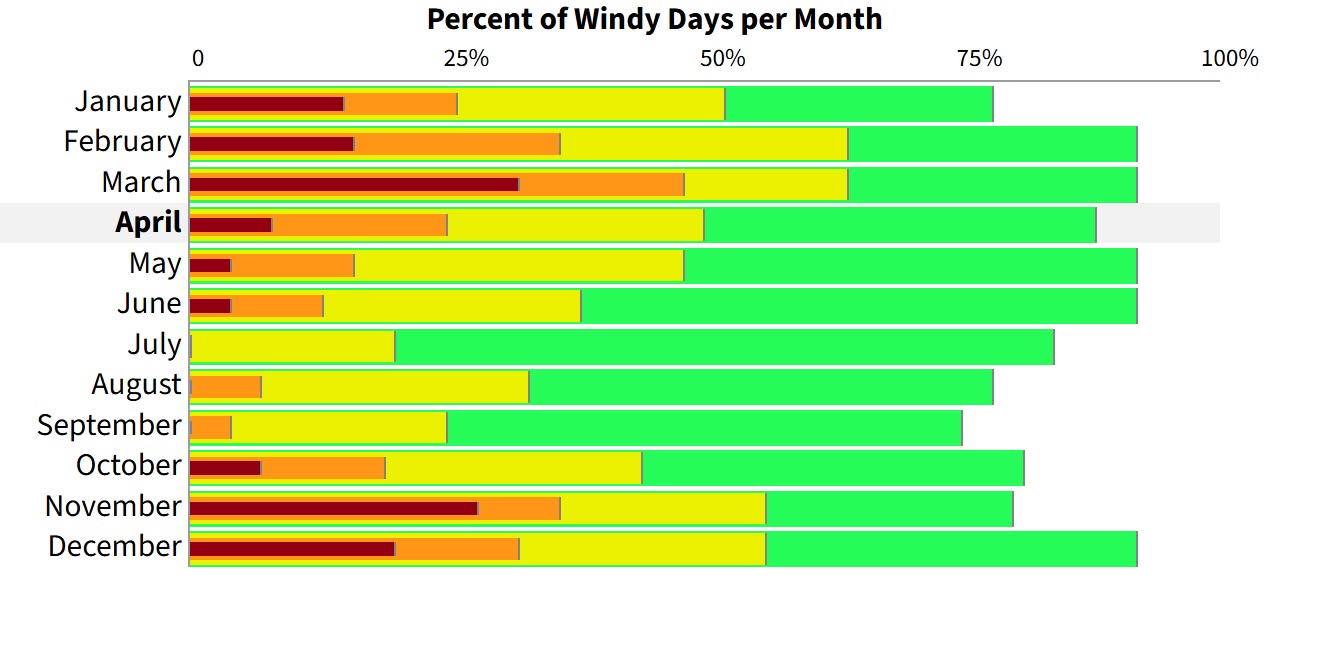

West Point Annual Daylight Wind chart: windalert.com
Public Boat Launches
Races
-
- …
.
Safety
- Puget Sound is cold water paddling. The average monthly water temp varies from 6 degrees Celsius (42.8 Fahrenheit) to 13 degrees Celsius (55.4 degrees Fahrenheit ). When in doubt, dress to swim.
- The Coast Guard has a program where you may register your GPS/DSC radio and with one button push they will know your location and that you need assistance.
- Shipyard Rules and Safe Distances - from commercial/gov docks and ships
Adaptive Paddling
Injury and Recovery
Clubs, Coaching, Groups
Surfski (& Other Paddlers)
Outrigger
- Kikaha O Ke Kai (Tacoma)
Coaches
- Seattle
- Seattle Canoe and Kayak Club (there are more sprint kayak/canoe clubs in Puget Sound)
- Farther Afield
- …
Boat Dealers
Surfski Dealers
- Epic
- Aqua Adventures Seattle boating accessories
- Farther Away
- Bellingham Dealers Carbonology Sport, Epic, Think, Fenn, Nelo, Nordic Kayak
- Gorge Area Dealers (click on link to expand) Carbonology Sport, Epic, Think, Fenn, Nelo, Nordic Kayak, Kai Wa'a
- Vancouver, BC Coast Outdoors Epic, Think
- +16049872202 info@coastoutdoors.ca
- …
Outrigger Canoe Dealers
- Paddle Zoo - OCs and SUPs
- …
Repair
- …
Storage
Rental
- Seattle Rotomolded V7, V5 Aqua Adventures
- …
Resources
Except where otherwise noted, content on this wiki is licensed under the following license: CC Attribution-Share Alike 4.0 International


